How to get found online? Provide real answers to design engineers’ questions.
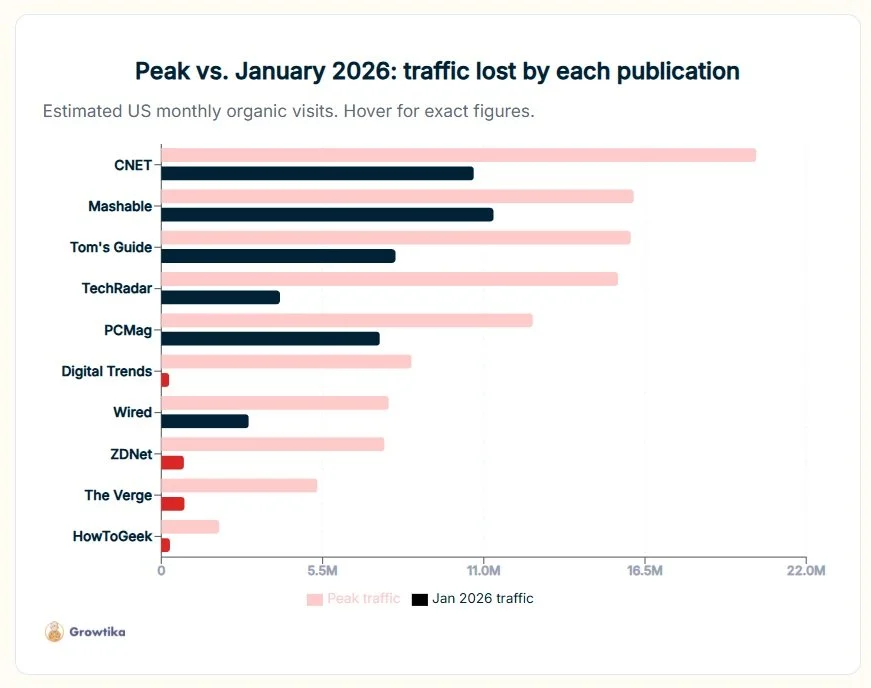
Search traffic to technology publications has fallen off a cliff since the introduction of Google AI overviews. Graph from Growtika.com.
One graph featured in the awesome Noahpinion Substack recently brought home to me more vividly the effect of AI on SEO than tens of articles and papers have done. Author Noah Smith referred to statistics in a Growtika article which show precipitous falls across the board in the number of visitors clicking through from Google search to the US’s top online tech publications in January 2026. The declines in traffic ranged from 30% to more than 90%.
According to Growtika:
‘The steepest declines started in mid-2025, coinciding with the expansion of Google's AI Overviews’.
There is no reason to think that this trend is not going to become even more pronounced as more and more web users adopt AI as their primary information and knowledge acquisition tool.
What does this mean for those of us responsible for marketing communications at semiconductor and other deep tech companies? I draw three main conclusions:
1. Traditional keyword-based search engine optimisation (SEO) for most B2B companies is in deep trouble. It already costs an enormous amount of effort to produce keyword-oriented pages in order to compete against tens or hundreds of other companies chasing the same keywords. The switch to AI overviews instead of conventional search engine results means that the return on the investment in keyword content has cratered. Keyword-driven Google search results are no longer going to suck in a flood of high-value prospects to important technical sections of your site.
2. Electronics design engineers and other types of deep tech customers are rapidly going to become more adept at using AI chatbots to answer their important engineering questions.
Today, the limit to the usefulness of an AI chatbot’s answers is set by the availability of information published on the web: the limit is not the underlying LLM technology.
The internet might be an astonishing trove of information and insight, but in the field of electronics and embedded systems design, much information that could be useful to a design engineer remains unpublished: this category of information includes, for instance, the know-how locked inside the heads of applications engineers or product specialists, and only shared in person with key global customers. It also includes customer- or sector-specific value propositions which are delivered in person by sales or product marketing executives, perhaps backed by a slide deck which is incomprehensible to an LLM in the absence of a verbatim record of the pitch made to the customer.
For products which fall below the highest priority for marketing support, even basic information about the comparative value of the product against competing options might not exist, because in the past there was never any expectation that such a value proposition would be requested or viewed.
This leads me to my third conclusion:
3. The rational response of semiconductor companies should be to create and publish much more, and more useful, information about their products and technologies for LLMs to learn from. In part, this can be achieved by making existing information (such as datasheets in pdf form) easily machine-readable.
But more importantly, it means providing information which answers the real questions that real engineers have about semiconductor products and technologies. Today, semiconductor companies provide this information – if at all – only for their highest-priority product launches. In future, every new product should be supported by its own dedicated set of materials which answer the questions that the typical customer’s typical engineer would ask the typical field applications engineer, if only they had access. It means creating FAQs, application guides, competitor comparisons, objection rebuttal scripts, an extended value proposition statement, machine-readable performance and operating specification tables, and more, for every single product in the company’s portfolio.
And the key to handling this mammoth new content-creation effort? The use of marketing-guided AI chatbots to automate the creation of the comprehensive text- and image-based information store that engineers have always wanted, but have never before been able to find.
This calls for a new approach to product marketing communication at semiconductor manufacturers and other deep tech companies. It requires marketing communications and business development executives to deploy skills in:
Understanding customer perspectives on product propositions
Structuring text- and image-based assets to align with customer perspectives
Architecting the new full-spectrum product information assets to optimise for both LLM readability and user navigation
For an introduction to this new approach to product marketing communication, contact Tim Weekes Communications Consulting and request a discovery call.